Remediating Salt Damage to Lawns from Winter Deicing Applications

Winter safety depends on deicing products like rock salt (sodium chloride) on roads, sidewalks, and driveways. They melt ice effectively, but they are hard on the soil and plants around them. Season after season, repeated salt applications drive high concentrations of sodium and chloride into the root zone, leading to soil degradation, plant stress, and long-term landscape damage—most of it concentrated in the turf within about 30 feet of pavement.
The good news for landscape professionals and property managers: salt damage is both preventable and repairable. The key is treating the soil on two timelines—getting it ready before deicing season, and helping it recover after. This guide covers how salt harms turf, where it hits hardest, and how to build a soil program around Mirimichi Green CarbonizPN® and CarbonizPN®-G that makes your soil more resilient to salt.
How Deicing Salts Damage Soil and Plants
Sodium ions from deicing salts disperse soil particles, breaking down soil structure and reducing permeability. The resulting compaction limits water infiltration and root growth, creating an inhospitable environment for turf. Chloride ions accumulate in the root zone, disrupting nutrient absorption and causing physiological drought—when water is present in the soil but unavailable to the plant. The result is weakened, discolored turf, stunted growth, and, in severe cases, dead patches.
The impact is most pronounced along roads, parking lots, walkways, and driveways, where salt-laden snowmelt concentrates in the soil. For the crews who manage these properties, that creates a recurring, predictable problem—which is exactly why it can be planned for.
Two Windows to Act: Before Winter and After
Most salt-damage advice focuses on spring cleanup. But the soil science points to a second, earlier opportunity.
Before the season (proactive). CarbonizPN works through its soil chemistry: the biochar component has a high cation-exchange capacity that helps bind and buffer sodium, while releasing calcium, potassium, and magnesium into the root zone; the mature compost component improves soil structure so water—and the salts dissolved in it—can move down and through rather than accumulating. Those mechanisms work best when the amendment is already in the soil before the salt arrives. Incorporating or topdressing CarbonizPN-G in late fall, before the ground freezes, gets that chemistry in place for the deicing season ahead. Research on salt-affected soils has shown biochar and compost can substantially lower sodium indicators and improve how readily salts leach; while those studies are on croplands rather than salted lawns, the underlying mechanism is inherently preventive, which is why a fall application is a sound, low-risk way to build salt resilience ahead of winter.
After the season (remediation). At spring green-up, once snow is gone and temperatures are above freezing, treat the areas that took the most salt. This is when leaching, amendment, and reseeding do the most good (see the integrated program below).
A practical pattern for high-exposure sites: a fall CarbonizPN-G application before snow, then a follow-up assessment and treatment after snowmelt.
Where Salt Damage Hits Hardest
Deicing-salt damage is a Snow Belt story. The U.S. uses millions of tons of road salt each winter, and a handful of states—New York, Ohio, Michigan, Illinois, Pennsylvania, and Wisconsin—account for roughly three-quarters of it. This is cool-season turf country (Kentucky bluegrass, perennial ryegrass, and fescues), and it is where deicing damage to lawns is most common. The transition zone—including tall-fescue lawns across the Mid-Atlantic, the Carolinas, the Tidewater region, and Kentucky—also sees meaningful exposure wherever snow and ice are managed with salt. In the warm-season South, deicing salt is rarely the issue; there, salinity concerns are usually tied to irrigation water or coastal flooding and storm surge.
If you manage properties in these regions, the timing is predictable: build soil resilience in the fall, and plan for remediation at green-up.
Restoring and Protecting Soil Health with CarbonizPN
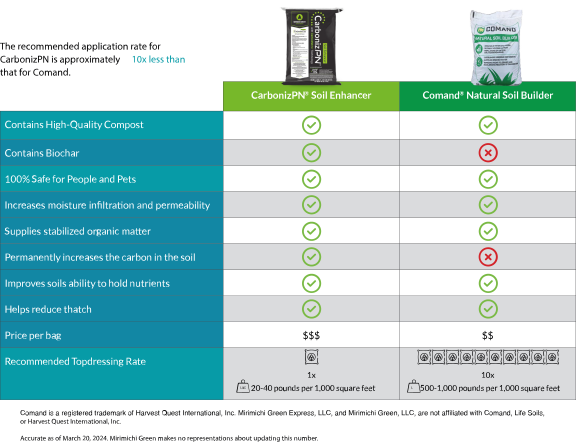
Mirimichi Green CarbonizPN and CarbonizPN-G are blends of biochar and mature compost—a combination that addresses both sides of a salt problem:
- Sodium buffering: Biochar’s charged surfaces help bind and hold sodium ions, reducing their availability to disperse soil and stress roots, while supplying calcium, potassium, and magnesium.
- Soil structure and leaching: The mature compost adds organic matter that improves aggregate stability, infiltration, and water movement—so salts drain through the profile instead of concentrating in the root zone. Independent leaching research has found that organic amendments like compost improve how effectively salts flush out of soil.
- Biological recovery: The compost feeds beneficial microbial activity, supports nutrient cycling, and encourages root development—rebuilding the fertility and structure that sodium strips away.
Because these benefits are about conditioning the soil, CarbonizPN fits both windows: a resilience-builder in the fall and a recovery tool in the spring. The granular CarbonizPN-G is well suited to fall topdressing and core-aeration passes on turf.
An Integrated Salt-Management Program
Salt-affected soil responds best to a program, not a single product. CarbonizPN is one part of a soil-test-driven approach:
- Test first. A soil test tells you whether you have a salinity problem, a sodium (sodic) problem, or both—and that determines the fix. Don’t apply gypsum blindly; it only helps when sodium is the issue.
- Leach with water. Deep, gentle irrigation—or spring rains—is the primary tool for moving dissolved sodium below the root zone. In many cases this does most of the work.
- Apply gypsum if the soil is sodic. Calcium in gypsum displaces sodium on soil exchange sites so it can leach away. Follow your soil-test and product-label rates.
- Build organic matter and improve structure. This is CarbonizPN’s lane—improving infiltration and aggregate stability so the leaching above actually works, and buffering sodium in the process. Think of it as complementary to gypsum and leaching, not a replacement.
- Reseed or sod dead areas as needed once the soil is in shape to support establishment—time recovery seeding with our fall overseeding tips.
For recovery and establishment, pair CarbonizPN with Mirimichi Green Release products (Release 901C, 202, or Zero) to accelerate germination and root-mass development.
Application Guidelines
Mirimichi Green recommends the following CarbonizPN rates, scaled to the severity of salt exposure or damage:
- Supplemental: 20 pounds per 1,000 square feet
- Standard: 30 pounds per 1,000 square feet
- Premium: 60 to 80 pounds per 1,000 square feet
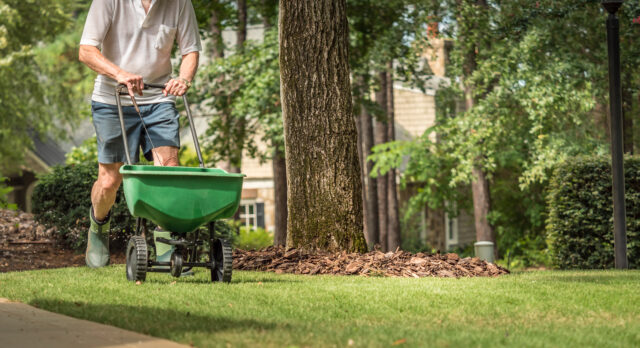
For a proactive fall program, apply CarbonizPN-G ahead of the ground freezing—ideally paired with core aeration so the material works into the root zone—concentrating on the high-exposure strips within roughly 30 feet of pavement. For spring recovery, apply after snowmelt alongside leaching and, if indicated by a soil test, gypsum. Release products are typically applied at 2 to 8 ounces per 1,000 square feet depending on the level of enhancement desired.
Why This Matters Now
Two trends are reshaping winter maintenance. First, road-salt costs have climbed sharply—many municipalities have seen per-ton prices jump well above $100, in some cases roughly doubling year over year—pushing crews toward reduced-salt and brine programs. Second, there is growing environmental and regulatory attention on chloride in lakes, streams, and groundwater, where it persists for years. In response, “smart salting” and applicator-certification programs are spreading, all aimed at using less salt while still keeping surfaces safe.
That shift plays directly to a soil-health strategy: as the industry works to apply less salt and manage its effects, products that help the soil resist and recover from the salt that is used become part of a more sustainable program—one that protects both the landscape and the budget.
Frequently Asked Questions
Can I use CarbonizPN to prevent salt damage, not just fix it? CarbonizPN isn’t a shield that stops salt, but applying it in the fall conditions the soil—buffering sodium and improving drainage—so turf is more resilient to the deicing season ahead. It works best as part of a soil-test-driven program.
When should I apply it? For prevention, in late fall before the ground freezes. For remediation, at spring green-up after snow is gone and temperatures are above freezing.
Does CarbonizPN replace gypsum? No. Gypsum addresses sodium specifically when a soil test shows a sodic problem; CarbonizPN improves organic matter, structure, and drainage. They work best together, alongside leaching.
Where do I start? With a soil test, so you treat the actual problem—salinity, sodicity, or both.
By building CarbonizPN into both your fall and spring programs, you can strengthen salt-stressed soils before damage occurs and speed recovery when it does—protecting long-term turf health in the areas that take the most abuse. Contact Mirimichi Green to learn how CarbonizPN and CarbonizPN-G fit your winter salt-management program, or find them at 1,400+ supply branches nationwide, online, and by the pallet.